Anatomy of a saree
Five words that come up constantly, and a diagram that makes all of them obvious.
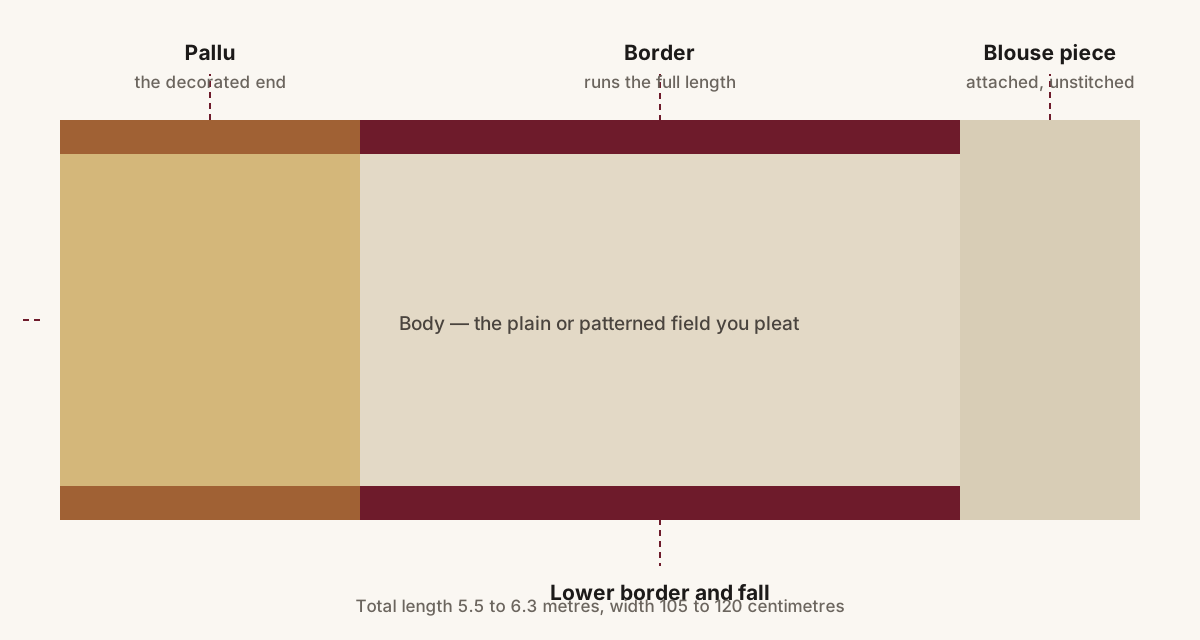
The five parts
Pallu
The decorated end. This is the piece that goes over your left shoulder and hangs down your back, so it is the part people see most and the part weavers put the most work into. On a Paithani the pallu is a separate tapestry weave. On a Banarasi it is the densest brocade. If a saree has one obviously special end, that is the pallu.
Body
The long middle section. This is what you pleat at the waist, so it is usually the quietest part of the design — small repeating motifs, or nothing at all. A busy body and a busy pallu fight each other.
Border
The strip running the full length of both long edges. It gives the saree its structure and weight at the hem, which is why a saree with a heavy border hangs better. On a Kanjivaram the border is woven separately and joined, which is why its colour can be completely unrelated to the body.
Blouse piece
A length of matching fabric — usually 80 to 90cm — attached to the far end of the saree, meant to be cut off and made up into a blouse. It is flat fabric, not a blouse. If you have never bought a saree before this is the single most common surprise, which is why we state it separately on every product page.
Petticoat and fall
Neither is part of the saree, but neither is optional. The petticoat is an A-line underskirt you tuck the pleats into — it is what the whole drape hangs from, and it is what stops a sheer saree being see-through. The fall is a strip of cotton tape sewn inside the bottom edge so the hem has enough weight to hang straight rather than flapping.
Lengths, and which to buy
Most sarees are 5.5 metres. Some — Kanjivaram, Paithani, and anything intended for a traditional nine-yard drape — run 6.3 metres or longer. The extra length is not about your height; it is about how many pleats the style needs and how wide the pallu drape is.
- 5.5 metres suits the common modern drape (Nivi style) at any height.
- 6.3 metres and over gives a fuller pallu and enough fabric for regional drapes.
- Width is 105 to 120cm. Wider means a longer drop, so taller wearers usually prefer 115cm and up.